
Progress on the 21 Recommendations
Defining Implementation Progress
Based on Douglas Ruck’s presentation of the report on October 29, 2024, successful implementation will mean ensuring this report does not sit on a shelf and creates sustained operations to address systemic discrimination in the legal profession.
"Do whatever it takes to make it part of the ongoing work of the Society and the firms."
- Douglas Ruck, KC, October 29, 2024, Presentation to NSBS
Progress is defined as integrating the recommendations into the ongoing operations of the Society and promoting their adoption within legal firms.
Implementation Maturity Model
Purpose
To ensure that this progress is both visible and measurable, the implementation maturity model offers a structured approach for tracking how deeply the recommendations are being embedded across policies, practices, and professional culture. Rather than viewing implementation as a one-time initiative, the model emphasizes sustained engagement and integration, aligning equity goals with the day-to-day functions of the legal profession.
By outlining clear stages of maturity, the model enables the Society and its partners to move beyond awareness toward demonstrable transformation. It equips legal institutions with a roadmap for continuous improvement, ensuring that implementation is not dependent on individual champions but built into organizational systems and expectations. This approach supports long-term accountability and creates the conditions necessary for sustainable change within both the Society and the broader legal community.
Implementation Rubric
Each recommendation was assessed by examining the work currently underway within the Society to determine its stage of implementation. This assessment recognizes that meaningful change unfolds over time and through varying levels of organizational commitment and integration. The goal is not merely to identify whether action has occurred, but to understand how deeply each recommendation has been embedded into structures, processes, and culture across the Society and within the broader legal profession.
To do this, a seven-point implementation rubric is being used to determine the maturity level of each recommendation.
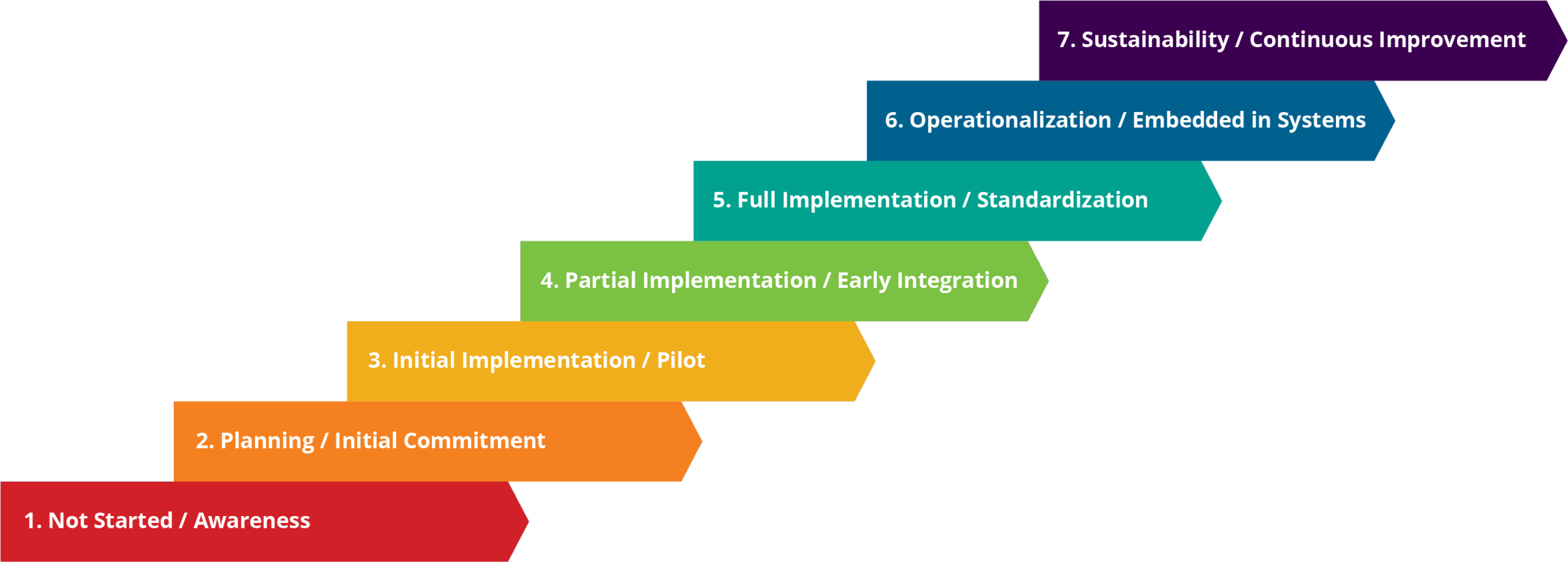
- Not Started / Awareness: Recommendation identified but no concrete action has begun; may only exist in discussion.
- Planning / Initial Commitment: Leadership has acknowledged the recommendation and planning or exploration is underway.
- Initial Implementation / Pilot: Early action is being tested, such as a pilot or one-time initiative.
- Partial Implementation / Early Integration: Practices are expanding across units but remain inconsistent and accountability is limited.
- Full Implementation / Standardization: A standardized policy or process exists across the organization, though it may still function as a compliance measure.
- Operationalization / Embedded in Systems: The recommendation is integrated into ongoing systems, supported by resources and accountability structures.
- Sustainability / Continuous Improvement: The practice is fully embedded in organizational culture, regularly reviewed, and improved based on outcomes and feedback.
This rubric allows for a nuanced view of progress, making it possible to identify where momentum exists and where further support, accountability, or cultural shift may still be needed.
Prioritized Recommendations 2025-2026
With recommendations #1 and #2 furthest along in implementation, the following recommendations were prioritized for this year through extensive consultation with the Implementation Task Force and our NSBS Management Team:
- # 3 - Review and Modernize Anti-Discrimination Policies and Regulations
- # 4 - Establish Reporting and Investigation System Including Whistleblower Safeguards and Representation from Equity Deserving Communities
- # 8 - Revise Code of Professional Conduct
- # 12 - Require Collaboration with Equity-Deserving Groups
Progress Report
Keep checking this space for regular status updates.
| Recommendation | Relevant efforts | Rubric rating |
|---|---|---|
| 1. Appoint Independent Implementation LeadM | Commissioning the Ruck Report; led search process for an Independent Implementation Lead | Operationalization/Embedded in Systems (Internally) |
| 2. Require Mandatory Training and Resources on Systemic Discrimination | New required African Nova Scotian module (launch 2026); cultural competence framework rollout; The Path (Indigenous experience); de-escalation + difficult conversations (completed); training needs analysis; developed Competency Framework (including cultural competency) that is under equity lens review | Partial Implementation / Early Integration |
| 3. Review and Modernize Anti-Discrimination Policies and Regulations | Drafted Respectful Workplace Policy updates; updating D&H policy + complaints process; embed systemic discrimination understanding; duty-to-report consultation + mid-Dec feedback for amendments; helped modernize LOSMC Equity and Diversity Standard; revisions are complete, equity committees reviewed them, and the draft goes to Council in February 2026 | Initial Implementation/Pilot |
| 4. Establish Reporting and Investigation System | Updating complaints process; proposal for trauma-informed complaints process consultant; engaged in duty-to-report consultation, encourage lawyers to bring a support person during disciplinary processes, completed a jurisdictional scan of D&H best practices in professional responsibility, including Ombud | Initial Implementation/Pilot |
| 5. Collect, Analyze and Share Discrimination Related Data | Demographic info via annual lawyers report; enhanced analysis; self-assessment + education survey + curriculum from results; articling clerk survey; newsletter analytics | Initial Implementation/Pilot |
| 6. Implement Access Accommodation Policy | Drafted Accommodations Policy; creating an accommodations policy for the discipline process; exploring bringing a support person to discipline processes | Planning / Initial Commitment |
| 7. Strengthen Disciplinary Aspects of Harassment and Discrimination Policies | Updating D&H policy + complaints process; duty-to-report consultation | Planning / Initial Commitment |
| 8. Revise Code of Professional Conduct | Ongoing consultation with Nat’l code of conduct standing committee; duty-to-report consultation + mid-Dec feedback on amendments | Planning / Initial Commitment |
| 9. Establish Diversity Recruitment and Mentorship Programs | Drafted Fair Hiring Policy; job postings shared with equity committees; conducting a scan of hiring policy templates; sharing postings with community contacts; IB&M initiative support; administering scholarships for equity-deserving articled clerks | Partial Implementation / Early Integration |
| 10. Ensure Diverse Representation & Intersectionality in Leadership | Commissioned external governance report; Equity Coalition launched to streamline decisions | Planning / Initial Commitment |
| 11. Provide Resources for Victims of Discrimination | LIANS peer support counsellors available; Complaints Investigation Committee support person encouraged; trauma-informed complaints process proposal (supportive design) | Planning / Initial Commitment |
| 12. Require Collaboration with Equity-Deserving Groups | Member of Federation of Law Societies of Canada’s Standing Committee on the Model Code, supported CTA 27–related amendments and met with stakeholders; Equity Coalition; IB&M initiative; Dara Gordon event; allyship debrief facilitation; articling clerk survey collaboration; advocacy plan development; hosted a red dress day event in May with a member of the Friendship Centre putting on a workshop for NSBS staff; NSBS/ISANS ITL Observership Program | Partial Implementation / Early Integration |
| 13. Revise Council Succession Plan to Ensure Diversity | Commissioned external governance report (succession elements not specified but commonly included) | Planning / Initial Commitment |
| 14. Safeguard and Support Equity-Deserving Members of Council | Facilitated session/debrief with council on 2SLGBTQIA+ allyship; Cultural competence education has been included at each Council meeting over the past 3 years | Planning / Initial Commitment |
| 15. Ensure Religion and Spirituality Accommodations | Initial discussions have happened for a spiritual/religious accommodations policy. It was decided that it would become a part of the larger accommodations policy in the works. A sample policy has been shared. | Planning / Initial Commitment |
| 16. Conduct Periodic 360-Degree Council Reviews | Council members complete a brief two-minute evaluation after each meeting, plus a year-end evaluation and a final evaluation at the end of the two-year term. The President also conducts exit interviews with members as they conclude their terms. | Partial Implementation / Early Integration |
| 17. Require Accountability for Firms Supporting Discriminatory Practices | NSBS reviews whether firms are in compliance with practice standards related to equity and Diversity (e.g., Management System for Ethical Legal Practice Element #9, Law Office Managaement Standards #6- Equity and Diversity, Code of Professional Conduct 6.3 | Partial Implementation / Early Integration |
| 18. Foster a Cultural Shift in Practice Expectations | NSBS reviews whether firms are in compliance with practice standards related to equity and Diversity (e.g., Management System for Ethical Legal Practice Element #9, Law Office Managaement Standards #6- Equity and Diversity, Code of Professional Conduct 6.3 | Partial Implementation / Early Integration |
| 19. Bring Substantive Change to Society Governance and Regulations | Commissioned an external governance report with an equity lens. Still requires internal review by Coalition; ITF retreat coordination; Equity Coalition launch | Planning / Initial Commitment |
| 20. Conduct Legislative Review to Address Systemic Barriers to Progress | Commissioned an external governance report that includes elements of legislative review | Planning / Initial Commitment |
| 21. Ensure Ongoing Evaluation and Improvement | HR Training Needs Analysis; demographic data collection + deeper analysis; surveys feeding curriculum; newsletter analytics; Regaining Trust website | Planning / Initial Commitment |