
Progress on the 21 Recommendations
October 2025
Defining Implementation Progress
Based on Douglas Ruck’s presentation of the report on October 29, 2024, successful implementation will mean ensuring this report does not sit on a shelf and creates sustained operations to address systemic discrimination in the legal profession.
"Do whatever it takes to make it part of the ongoing work of the Society and the firms."
- Douglas Ruck, KC, October 29, 2024, Presentation to NSBS
Progress is defined as integrating the recommendations into the ongoing operations of the Society and promoting their adoption within legal firms.
Implementation Maturity Model
Purpose
To ensure that this progress is both visible and measurable, the implementation maturity model offers a structured approach for tracking how deeply the recommendations are being embedded across policies, practices, and professional culture. Rather than viewing implementation as a one-time initiative, the model emphasizes sustained engagement and integration, aligning equity goals with the day-to-day functions of the legal profession.
By outlining clear stages of maturity, the model enables the Society and its partners to move beyond awareness toward demonstrable transformation. It equips legal institutions with a roadmap for continuous improvement, ensuring that implementation is not dependent on individual champions but built into organizational systems and expectations. This approach supports long-term accountability and creates the conditions necessary for sustainable change within both the Society and the broader legal community.
Implementation Rubric
Each recommendation was assessed by examining the work currently underway within the Society to determine its stage of implementation. This assessment recognizes that meaningful change unfolds over time and through varying levels of organizational commitment and integration. The goal is not merely to identify whether action has occurred, but to understand how deeply each recommendation has been embedded into structures, processes, and culture across the Society and within the broader legal profession.
To do this, a seven-point implementation rubric is being used to determine the maturity level of each recommendation.
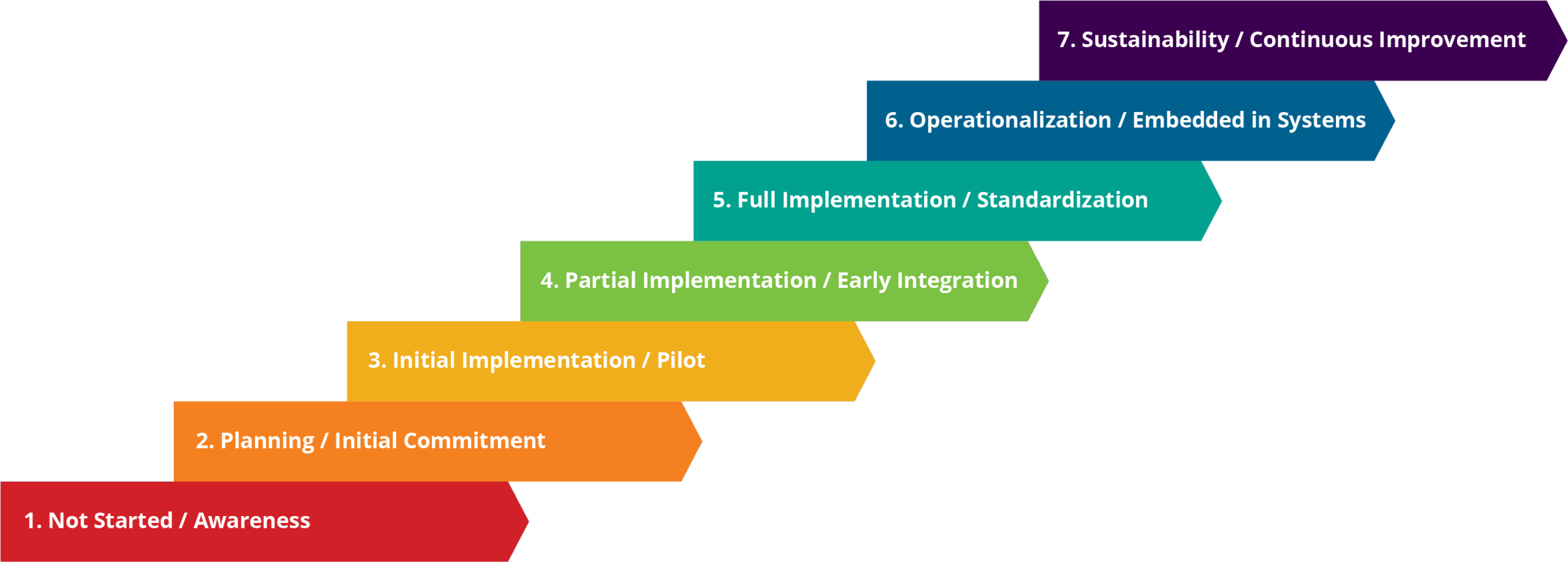
- Not Started / Awareness: Recommendation identified but no concrete action has begun; may only exist in discussion.
- Planning / Initial Commitment: Leadership has acknowledged the recommendation and planning or exploration is underway.
- Initial Implementation / Pilot: Early action is being tested, such as a pilot or one-time initiative.
- Partial Implementation / Early Integration: Practices are expanding across units but remain inconsistent and accountability is limited.
- Full Implementation / Standardization: A standardized policy or process exists across the organization, though it may still function as a compliance measure.
- Operationalization / Embedded in Systems: The recommendation is integrated into ongoing systems, supported by resources and accountability structures.
- Sustainability / Continuous Improvement: The practice is fully embedded in organizational culture, regularly reviewed, and improved based on outcomes and feedback.
This rubric allows for a nuanced view of progress, making it possible to identify where momentum exists and where further support, accountability, or cultural shift may still be needed.
Prioritized Recommendations 2025-2026
With recommendations #1 and #2 furthest along in implementation, the following recommendations were prioritized for this year through extensive consultation with the Implementation Task Force and our NSBS Management Team:
- # 3 - Review and Modernize Anti-Discrimination Policies and Regulations
- # 4 - Establish Reporting and Investigation System Including Whistleblower Safeguards and Representation from Equity Deserving Communities
- # 8 - Revise Code of Professional Conduct
- # 12 - Require Collaboration with Equity-Deserving Groups
The 21 Recommendations
At the time of launching RegainingTrust.ca, we are still determining the "maturity level” number for each recommendation, using the seven-point implementation rubric. An up-to-date report will be released by the Independent Implementation Lead before the end of the year. Keep checking this space for regular status updates.